Wednesday, 1 May 2013

Oriental structures


Next on my list of building projects are Russian and Oriental structures. My search on the Internet pulled up more information for Oriental structures than Russian, so I will begin with Chinese.

The Oriental/Chinese structures would follow a similar pattern as the Mediterranean project; a modular BUA and a separate edifice. Modular, as I could add sections to the village to lay a maximum size BUA.  The edifice, in this case a magistrate’s villa, could be integrated with the BUA or set apart.

Using keywords as Chinese architecture, feng shui, and Chinese movie sets brought a number of blogs dedicated to those subjects. Noteworthy are the differences in design from province to province and pattern of roof. I was pleased with the fact that many designs remained in use throughout the Ming and Qing dynasties.

In addition to the structures, I would add several junks to add to the ambiance of village adjacent to a waterway.

In the photo, the structures, walls and towers have been cut and shaped. Thick paper cover the roof of each structure to give an even surface when adding the tiles. The colour of tiles follows a prescribed building code; grey for ordinary structures, yellow for Imperial buildings, and blue or green for important buildings.


At this moment, I will paint the buildings and tiles before basing them as I need to play with combinations of pieces and bases sizes. So nothing will be fixed for the moment.

Cheers, 

Saturday, 27 April 2013

Buildings based and ready for use


The Mediterranean style building project stalled lacking triplex wood for bases. My local supplier promised to have stock the following week. That was over three weeks ago.

Stock arrived, so I bought enough for a dozen DBA sized armies and future BUA projects; Russian village and church, Chinese village and docks and more.


The photo shows the individual pieces with Woodland Scenic material serving for vegetation. Three pieces serve for the village and the larger piece as a farm or convent. I like the modular system, as I can adjust the area covered or spread the pieces over the table for a historical game.


Small trees (Woodland Scenic) are based separately as they can be used for other period BUA.  

The last photo show all the pieces clustered as an example of a large village.
Cheers,  

Thursday, 11 April 2013

Part 2 – Mediterranean style structures


The “tiled roofing” was quite fragile, such that any indentations would not come out. This had to be applied over an even surface, so I covered each roof with card stock to improve the bond and smooth the roof surface.

Before applying the roof, I needed to undercoat the structures and did this with an earth tone. Some walls were pitted, so daubing white over the earth would leave places uncovered, but importantly the overall structure would not appear even; areas close to the ground would become dis coloured through dust and moisture.


With a marker, I sketched roughly where windows and doors would be. Doors and windows were painted in and typical of the style, I added shutters  painted green. With a fine micro-pen, I outlined the features to tidy the overall illusion.

Adding the tiles was the last step and this was done for both buildings and walls. These too, were undercoated with standard white household paint and hardened when dry. This was an ideal surface to wash a terracotta colour and dry-brush.


The BUA and farm must be based first before adding the finishing touches of shrubbery, ivy and trees. Unfortunately, my local supply shop exhausted their stock of 1.5 mm basswood, so I shall have to wait.

In the meantime, the Russians have arrived from America. 

Wednesday, 10 April 2013

Mediterranean style structures


While waiting for my order of OG15 Napoleonic figures, I kept myself busy with constructing more BUA and edifices. On my projects list were buildings for the Duchy of Trento (Northern Italy).

From the bag full of useful size scraps of pink foam, I selected enough for a hamlet and a possible enclosed feature; farm or convent.


A simple bread knife is useful when shaping the building walls and roof. My first attempt need some correction as the pitch of the roof was appropriate for the snow bound regions of Germany than the warmer climate of Italy.


The roofing is packaging from tea biscuits (cookies) sold here. Scoring this would effectively create the tiles for the buildings and walls.

More later.

Wednesday, 6 March 2013

Ottomans vs. Hungarians, latest revision 3.0

Last month I finished three armies of Ottomans but not had the time to use them in battle. Following the discussion about LH rear support and flee movement I decided to test them last night. 

Both Ottoman and Hungarian armies are based on the proposed lists for 3.0 giving the Ottomans an element of Serbian knights and the Hungarian better options balancing cavalry and foot. 

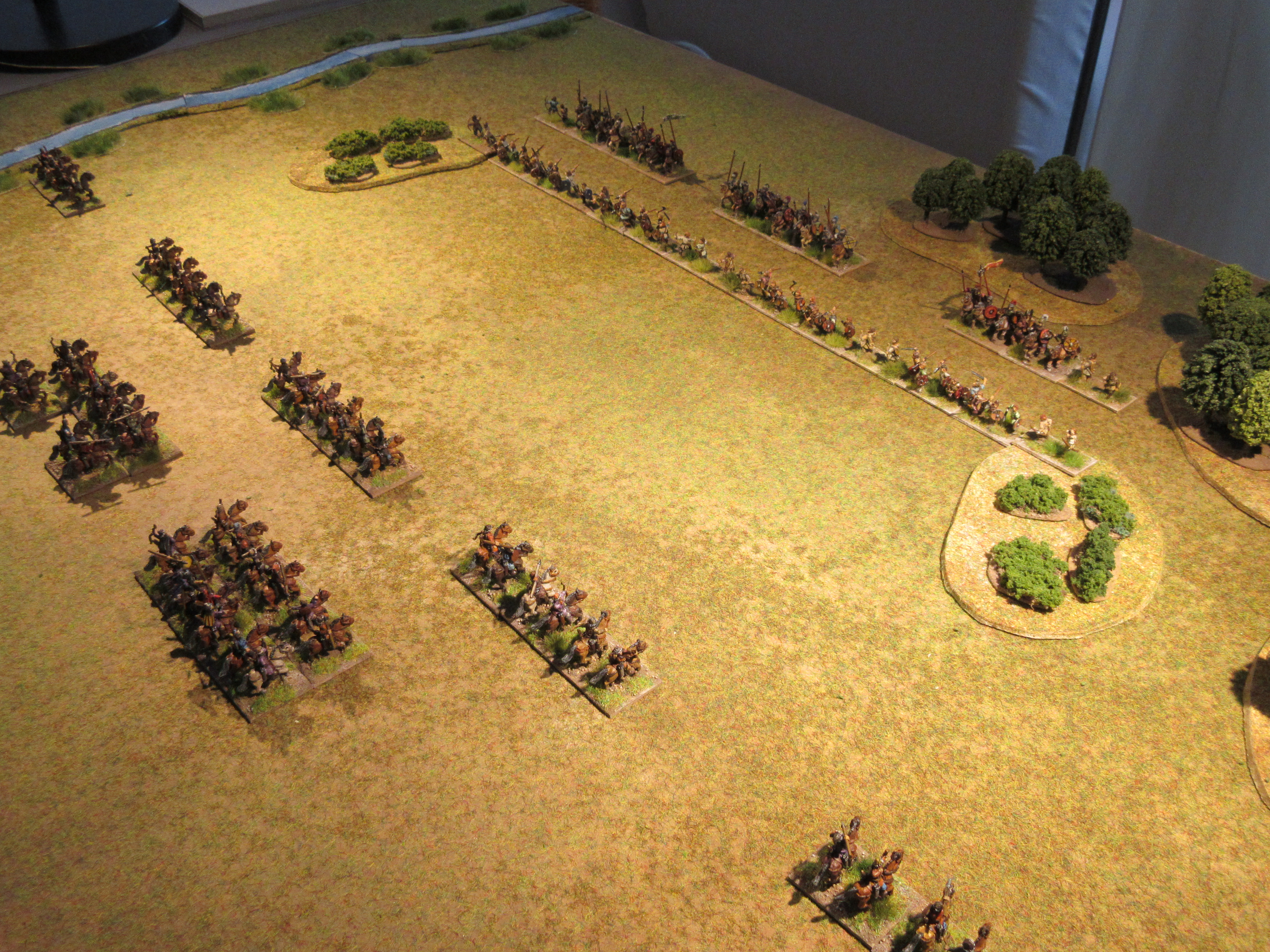
Photo 1
Between the woods and low hill, the Ottomans are deployed in a deeper formation to meet the Hungarian infantry wall. Supporting the infantry wall are Hungarian knights and positioned to the left flank are light cavalry. 


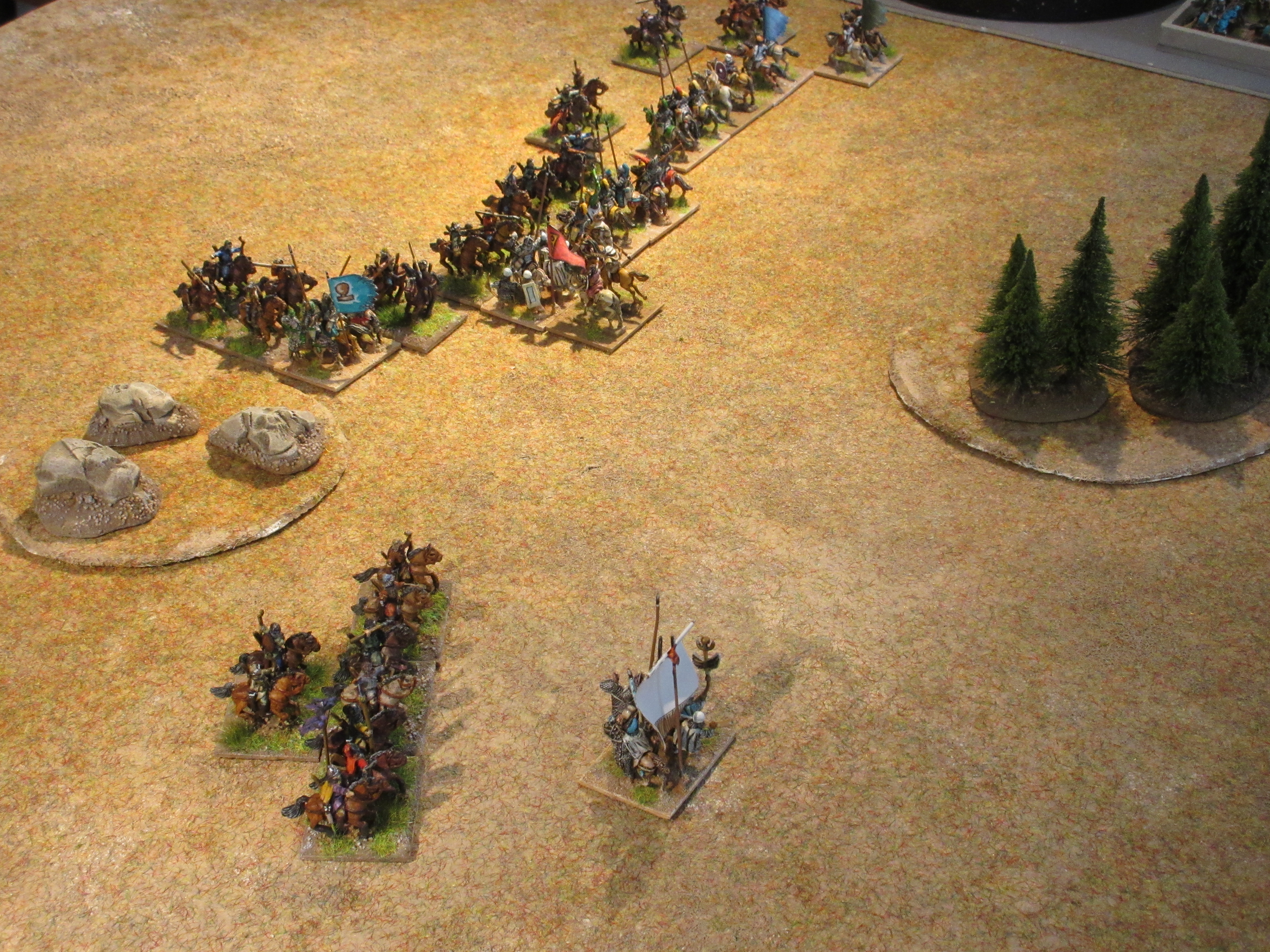
Photo 2
Ottomans center advance while extending their right to envelope the Hungarian left wing.


Photo 3
Hungarian LH, now occupied to their front are helpless to counter the Ottoman Akinjis flanking move. Hungarian knights and skirmishers are dispatched to deal with them. Center is now engaged while the Ottoman left flounder against the Cumans. 0 – 1 Hungary.


Photo 4
The Hungarian infantry hold the Ottomans, who are now helpless to make any break through. Even the Ottoman heavy cavalry are stopped at the base of the hill. 0 – 2 Hungary.


Photo 5
The only units fleeing were skirmishers. LH were tenacious and died on the spot. Here, the Serbian knights have broken through and beating the Hungarian CinC back. Hungarian casualties fell in quick succession, but at cost to the Ottomans. 2 – 3 Hungary.


Photo 6
Ottomans, catching their second wind, sent their lights to support the left wing and center. Ottoman reserves deployed to support the Serbian struggle while the Akinjis, behind the Hungarian lines became active. The Hungarian response, with a pip roll of one, gambled and did the unexpected. Lights attacked the Akinjis uphill and beat the snot out of them. Horse meat is back on the menu. 3 – 4 Hungary.


The Rematch

Photo 1
Ottomans redistributed their winning side to the right flank. Cunning plan nr. 321: Anchoring the left on the woods, the right wing and center would move to the right forcing the Hungarian battle line to wheel. To the left and behind the woods held by skirmishers were two elements of Akinjis.


Photo 2
The oblique maneuver.


Photo 3 and 4
LH support did not shine this time, but delivered up another plate of horse meat. Hungarian battle line are wheeling at a quick pace forcing the Ottomans to counter with their heavy cavalry. Lower left, the Akinjis are bottled up by eager Cumans. 1 – 1


Photo 5
The Ottoman cavalry facing the Hungarian infantry are sliced, diced and sautéed. Unfortunately, the CinC was processed as well, ending the game. 1 – 4 Hungary.


LH rear support is much like a Christmas present, you don’t open it before time
Cheers, 

Thursday, 31 January 2013

Medicine and cures

The previous post, Disease and Health in Medieval Times covered the most common afflictions to medieval man. The “Black Death” of the 1340’s did periodically return throughout the next three centuries. In addition, due to poor health and sanitation, any assembly of an army would be visited by Dysentery. For the campaign organizer, losses resulting from health issues could be as devastating as combat. How did medieval man cure himself is the topic of this post.

Physicians
Mercantilism or the rise of commerce, brought not only wealth to the cities, but also disease. A physicians with a modicum of knowledge would stay in the cities where they received substantial wages and privileges. Catering predominately to the wealthy formal medicine was practiced and governed by the church; illness was divine retribution.


Knowledge of medicine from ancient text remained for the most part in the hands of the church with each monastery having an infirmary. Cultivating their own herbal remedies to treat some monasteries functioned as hospitals for the old, the disabled and traveling pilgrims.

Knowledge of herbal remedies lay not only with the church but also with women who performed practical medicine for their village. Some methods often combined Pagan cures or invoked spells. Naturally, these practices were frowned upon by the church, but calling upon the Christian God saints would remedy that.


Where the two practices collided meant religious persecution as being in league with the devil which meant execution.  

From a compendium of medieval diseases, these were the most common for our period:

Dysentery (the “bloody flux”)
An infection caused either by bacteria or amoebas, spread through contamination of food and water by infected fecal matter.

Symptoms: (Bacillary) After 1-6 days incubation, watery stools, fever, cramps, dehydration. In advanced stages, bloody stools, meningitis, conjunctivitis, and arthritis. (Amebic) Acute form: watery, bloody stools, cramps, fever, weakness. Chronic form: intermittent diarrhea, mild abdominal discomfort.

Result: Generally weakened condition.

Note: Endemic in medieval armies and pretty common in cities. Infantile diarrhea was a leading cause of death for infants. After the Black Death, many urban areas instituted public health reforms to improve sanitation and prevent these enteric fevers.

Ergotism (“St. Anthony's fire,” “holy fire,” “evil fire,” “devil's fire,” “saints' fire”)
Poisoning from a fungal infection of grain, especially rye.

Symptoms: (Convulsive) Degeneration of the nervous system causes anxiety, vertigo, aural/visual hallucinations, and the sensation of being bitten or burned; stupor, convulsions, and psychosis. (Gangrenous) Constriction of the blood vessels causes reddening and blistering of skin, then blackening, with itching and burning, and finally necrosis.

Result: 40% mortality. Lingering symptoms, including mental impairment, among survivors.

Note: Ergotism was known as a rural disease, particularly of marshy areas, and one that followed crop damage or famine; especially after a severe winter and a rainy spring. Children are more susceptible because of their smaller body weight. Because England did not rely on rye as much as populations on the continent, it suffered fewer cases of the convulsive type.

Influenza.
An acute, extremely contagious viral infection of the upper respiratory tract, spread by inhalation.

Symptoms: After 1-2 days, a sudden onset of chills and fever, headache, backache, muscular aches, and general malaise; weakness, prostration, nausea, eye pain, mental confusion. After 1-5 days the respiratory symptoms become more prominent: dry or sore throat, cough, runny nose. Serious complications include bronchitis and bacterial pneumonia.

Results: A few months, maximum, of resistance to repeated infection.

Note: Flu was not a major worry in the 14th century but became a scourge in the 15th. Because flu is very contagious it often forms epidemics, generally occurring in the winter or early spring.


Campaign use:

As you may have noted, the onset of dysentery is nearly a given while encamped for periods longer than a week. This would affect both sides, as the besiegers had no proper sanitation and the besieged having to cope with the extra population gathered behind its walls. Naturally, a good army would have an abundance of clergy to help heal the body and soul.

Repeated crop failure would bring on conditions of famine, but also be a source for additional disease for the stricken fields. Certainly ruinous for the local noble and whose adversaries would see this a divine intervention.

A severe winter would increase the chances of influenza. Keep in mind when designing event tables, many situations were a natural flow of “cause and effect”. So a brilliant harvest and well stocked for the winter period, a region would have less problem with influenza.

Further reading:

Monday, 28 January 2013

15th Century Timeline: 1451 to 1499


1452 In Europe, metal plates are being used in screw-type presses.

1453 Constantinople has been declining economically, in population and military strength. Using European artillery and experts, the Ottoman Turks break through Constantinople's walls. Disciplined Muslim forces capture the city. This ends Constantinople as the center of Eastern Orthodox Christianity and the heart of the remains of the Roman Empire.        

1453 The French capture Bordeaux, the last place the English hold except for the port city of Calais, on the English channel. The Hundred Years' War ends without a formal treaty signed and no renouncing of rights to the French throne by an English king. Nationalism had increased, and common people in England are upset at what they see as England having lost the war. With the end of the Hundred Years' War, trade revives and economic depression ends.

1453 Forty-one Jews are burned at the stake in Breslau, Poland.

1455 In the German town of Mainz, Johann Gutenberg, using metal type in a screw-type printing press, prints the "Gutenberg" Bible.

1456 Judges and commissioners in the archbishop's palace in the city of Rouen declare that Joan of Arc was innocent of the charges that led to her execution – after nineteen years of appeal and almost one year of hearings. The Archbishop declares the case ended.

1456 The Ottoman Turks overrun Athens, begin a stay that will last 400 years, and they turn the Parthenon into a mosque

1459 The Ottoman Turks have taken control of all Serbia

1461 Two families, both descended from King Edward III (who reigned from 1327 to 1377 and was of the Plantagenet dynasty) have been at war for years. One family is the House of York the other the House of Lancaster. This is the War of the Roses. Edward, from the House of York, defeats the Lancastrians at Mortimor's Cross. He is proclaimed king and ascends the throne as Edward IV.

1461 King Loius XI of France creates a postal service.

1463 The Ottoman Turks expand into Bosnia. They execute Bosnia's king, Stefan Tomasevic – the last of the Kotromanic dynasty. Assassination, as a means of resistance to foreign rule, is viewed by the Serbs of Bosnia as a heroic act

1466 An Albanian, George Kastrioti, also known as Skanderbeg, has led another successful resistance against an Ottoman invasion, and he is a hero across Christendom.

1467 In Japan a dispute over succession of the Ashikaga shogunate begins the Onin War, which exacerbates the strife between regional warlords (daimyo).

1468 Skanderbeg has been ill and dies in bed, and the Ottomans absorb Albania.

1468 In Egypt, al-Ashraf Qaytbay becomes the Mamluk sultan. He buys 46,000 more slaves from the his area of origin -- the Caucusus. These slaves are normally from ages ten to 20, shipped through the Turkish straits. It is a trade in the hands of the Genoese.

1469 Ferdinand of Aragon marries Isabella of Castile.

1477 France's Louis XI gains control of Burgundy.

1478 A conspiracy, that includes the Archbishop of Pisa and has the support of Pope Sixtus IV, leads to an attack on the Medici while they are in church. The Archbishop and several others are hanged. Pope Sixtus puts Florence under the interdict and excommunicates the Medici leader of Florence, Lorenzo de Medici. The pope forms a military alliance with the King of Naples, and Lorenzo's diplomacy prevents an attack.

1479 After four years of war, Spain accepts monopoly trade for Portugal along Africa's Atlantic coast and Portugal acknowledges Spain's rights in the Canary Islands.

1479 The Ottoman Turks and Venice have been at war since 1463. Venice is defeated militarily and gives up that part of its empire, along the Adriatic Sea, that the Ottoman Turks occupy.

1480 Leonardo da Vinci of Florence, age 28, of invents the parachute.

1480 Moscow's Ivan III feels strong enough to refuse to pay tribute to the Mongols
1481 Louis XI of France gains the territories of Anjou, Bar Mine and Provence.

1480 Ferdinand and Isabella of Spain employ the Spanish Inquisition to investigate whether converted Jews are secretly clinging to Judaism.

1481 Two Latvian monarchs are executed for murdering the Polish king, Kazimierz IV.

1482 Portuguese have founded new trading settlements on Africa's "Gold Coast." They are trading ironware, firearms, textiles and food for gold, ivory, food and slaves.

1482 The Ottoman Turks occupy Herzegovina and join it administratively with Bosnia. Its nobles and a large percentage of its peasants are to accept Islam.

1483 Edward IV of England has died. His son succeeds him as Edward V, and he is murdered. The Duke of Gloucester, the youngest brother of Edward IV, usurps the throne and is crowned Richard III.

1483 Pope Innocent VIII issues a statement deploring the spread of witchcraft and heresy in Germany. He orders that cats belonging to convicted witches be burned as well as the witches.

1485 Henry Tudor, a relative of the Lancaster family, defeats Richard III at the Battle of Bosworth. The Tudor family takes power and is crowned Henry VII.

1485 Henry VII marries Elizabeth of York, uniting the Lancaster and York families. The War of Roses is over.

1491 King Charles VIII of France invades Brittany and forces 14-year-old Ann of Brittany to marry him, adding Brittany to French territory.

1492 Spain's monarchs, Ferdinand and Isabella, do their part in a war against Islam – they annex Granada. Also they give Jews three months to convert to Christianity if they are to avoid banishment from the country. And the voyage that the monarchy is paying for, led by Christopher Columbus, sets sail for China by going westward.

1493 Christopher Columbus returns from the Caribbean, and later in the year he sails back to the Caribbean.
1494 Kings were doing what kings had been doing for ages: pursuing wealth, territorial expansion and control over people. This year Christopher Columbus – an agent for Ferdinand and Isabella – begins using people of the Caribbean as slaves.

1494 Piero de Medici has ruled since the death of his father, Lorenzo, in 1492. He makes peace with the French, who have invaded Tuscany (in which Florence is located). A political rising drives him into exile. Florence is in anarchy. A Dominican priest, Savonarola, is anti-Renaissance. He is opposed to popular music, art and other worldliness.

1496 Jews are expelled from Syria.

1496 Sultan Qaytbay dies at the age of 53 followed by grand amirs competing to succeed him.

1497 Boys working under Savonarola collect from homes things associated with moral laxity: mirrors, cosmetics, pictures, books, fine dresses, the works of immoral poets. Savonarola has these burned. Renaissance art work is lost. Pope Alexander VI excommunicates Savonarola.

1497 In Scotland, children are required by law to go to school

1498 Savonarola is hanged. An enraged crowd burns Savonarola at the same spot where he ordered his bonfire.

1498 Columbus sails from Spain with six ships on his third voyage to the Americas.

1498 Jews are expelled from Nuremberg and Bavaria.

1498 The Ottoman Turks invade Dalmatia and devastate land around Zara. Venice goes to war again against the Ottoman Turks.

Sources:
Compilations from various web sources including Wikipedia.